When Trials Come

November 18, 2010 — 3 Comments

Though you haven’t seen him, you love him, and though you do not now see him, you believe in him and rejoice with joy that is inexpressible & filled with glory. – 1 Peter 1:8

After reading tonight from Jonathan Edwards’ Religious Affections, I thought I’d pass along some good reminders about our experience of trials and tough times.

The verse above tells of a group that is experiencing trial and suffering, yet they are filled with joy. It should be an encouragement to know that others have fought their way through trials and still found joy in the midst of struggle. By faith, we can too.

I don’t know about you, but I have a hard time finding the good when I’m in the middle of a tough time in my life. That’s why I think it’s helpful that Edwards lists three benefits of trials.

First, trials tend to reveal that which is true and that which is false. That’s why they are called trials. I find this to be the case in distinguishing those who are authentic followers of Jesus from those who seem to believe as long as it is comfortable. But I also find that it reveals the true and the false in my own heart.

Second, trials show the glory and beauty of authentic faith. When a single mom faces unemployment and trusts that God will provide, it’s a beautiful thing. When a man is “circling the drain” (as a good friend of mine used to say) with cancer and keeps a joyful grin, it’s an inspiring thing to watch. As long as these are authentic displays and not put on, they are healthy signs of God’s peace. Trials show off God’s power in us. They say that we have a God who will never leave us of turn his back on us, even when our circumstances seem to say otherwise.

Third, trials purify and refine authentic faith. Trials have a way of surfacing the good as well as the ugly in us. Spiritual transformation never comes by pretending, so seeing the truth about our lives helps us grow. Trials teach us to let go of lesser loves that won’t deeply satisfy us or give us joy that lasts. Trials help us see that those things that distract us from Jesus just aren’t worth it. When we keep the faith and persevere during the tough seasons of life, our faith grows. As our faith in God grows, our joy becomes more rich and real.

So, let your faith be strong when you can see nothing but trials in your circumstances, and the unseen Jesus will give you indescribable joy. This is the promise that we trust when times are hard.

Does this resonate with your experience? What have you found helpful during tough times?

– jdl

Finding Compañeros

July 21, 2010 — 6 Comments

COMPANEROSI recently read Lonesome Dove, Larry McMurtry’s Pulitzer Prize winning novel made famous by the television miniseries many consider the greatest ever (starring Tommy Lee Jones and Robert Duvall). McMurtry’s story follows a group of men on a cattle drive from Mexico to Montana. In many ways, the book is about men, their internal drives or passions, and the friendships they share along the way. This motley group assembled over time, but the core of the group served as Texas Rangers during the days when they fought real battles throughout the region. Through many eventful, often difficult, years together, the men had become “compañeros.”  These relationships weren’t perfect, but they were characterized by intense loyalty, sacrifice, honesty, and memories. Every guy needs relationships like these, but few have them.

As I’ve observed guys who become real compañeros, I’ve discovered four things that create movement toward meaningful relationships: props, plans, risks, and laughs.

GUYS NEED PROPS

Women seem to get together with other women and start talking deeply without effort, but guys aren’t like that. You put them together and all you get is something along the lines of “how’s work?” or “you playing fantasy football again this year?” Those two conversations can fill an entire evening.

In general, guys don’t talk openly and freely without an external prop. It may be a task, a mission, a hobby, a shared history or some other event that brings them together. Men become close on a three-thousand mile cattle drive. They open up during a long winter in the trenches of wartime. They are brought together by an adventurous road trip. It isn’t always something grand. It may be something as simple as a regular hunting trip, a golf foursome or mission trip. It may be group of friends from your college dorm or a church small group. There is not any “magic” prop, but there is almost always some kind of prop that brings the guys together initially.

My group of friends and I came together as friends during college, but those friendships expanded through a college road trip to bury a “time capsule” on the Texas-Mexico border (modeled loosely on the movie, “Fandango”). We each included something of great personal value and a list of spiritual commitments and life goals in the bottle. Ten years later, we returned to dig it up. That event become an annual long weekend together that has become a highlight in our lives.

If you want to find real friends, I suggest you grab a group of guys and initiate some unique activity. In male relationships, activity opens the door for conversation. Men start talking deeply after they’ve worn themselves out, made fun of one another or blown something up in a bonfire.

GUYS NEED PLANS

Past performance does not guarantee future success. Just because some prop brought you together for a unique time of relating as friends, you may not continue in that kind of friendship in the years ahead. Most guys who have not found life-long compañeros reflect on certain friendships with a nostalgic longing to go back, maybe even with a tinge of sadness. They are sweet memories, but they are just that: memories of something good that once was but is now gone. Friends rarely intend to lose touch with one another. If your experiences together are going to grow into deep, lasting relationships, you need to commit to a plan.

With my group, we decided to take an annual trip together. We pick a destination and a date, and we all fly in for a long weekend each year. My “Fandango” trip with this group of 6 men helps me hit my annual laugh quota in single weekend. This takes a real commitment, but it’s worth everything it takes to make it happen. Our wives sacrifice on the home front to allow us to go. We take time off work. We split the costs evenly to make it fair (sometimes, we pick up the tab for one another when finances are tight). This commitment propelled us from being college friends to becoming life-long friends.

The bottom line is that you won’t become compañeros without regular time to laugh, play, and goof off together. This usually takes one person in the group who initiates an ongoing plan for being together and gets a commitment from the group. A plan creates a path for deepening relationships as you journey through the ups and downs of life together.

Most of the time, a particular place or activity becomes a big part of the group’s identity. Guys seem to have a desire for a tradition that makes this time special. As men move from the free-wheeling college years to the responsibility of their 30s and 40s, they need time “away” from the normal routine of life. I’d encourage you to try something that allows for a break from your normal responsibilities and demands some real commitment from one another.

GUYS NEED RISKS

The third element I see is risk. If there is no risk, you will settle into a cycle of conversation that repeats itself over and over without taking you anywhere. Think about your relationships with your father or brother or co-workers for a minute. I bet you could write a script for most those conversations as they revolve around the same topics with each phone call. This is just what guys do. We are strange beings. We privately long for a deeper relationship but we almost never acknowledge it.

Friends must continually take risks by sharing life at a vulnerable level. It amazes me how risky it feels to share what is happening in my heart even with my most trusted friends. We’ve been sharing life together for twenty years, but it still feels threatening to let them see my hurts, my unhealthy desires, my anger, my dreams, and my joys. It also brings freedom. The more I share, the more I’m freed up to be myself around them.

Most groups need a guy with the guts to be honest in front of others. Sometimes, it means saying, “You know what guys? I struggle with ______.” Or, “You know what hacks me off about my life right now? It’s ______.” In our group, it seems to be a different guy who leads out each year with an honest and bold statement about his life. Each time someone opens the door to his heart, I think to myself, “OK, here we go.” It’s become my favorite part of our trip. I find out that I’m not that weird, or maybe that I’m just as weird as everyone else. Somehow, that’s one of the things guys need to know: we are all jacked up. That kind of vulnerable sharing is relational fuel for men. Like a car, you have to refill the vulnerability tank regularly or the friendship runs out of gas.

GUYS NEED LAUGHS

With men, laughter both precedes and follows relational risks. Guys need to laugh, and I’ve found that guys won’t share openly until they have laughed freely. If you want guys to open up, you’d better crack one another up first. Some men don’t know how to laugh. Because of this, people will rarely feel comfortable enough around them to be honest about what’s in their hearts. Be careful sharing too much of yourself with men that can’t laugh. The other side of this is that men who have shared openly laugh even harder. The trust and confidence gained in deep relationships lead to uncontrollable laughs that roll out until they bring tears.

For guys, friendship never happens as spontaneously as we’d like. It takes props, plans and risks, but the investment leads to a kind of laughter that is only shared by true compañeros.

-jdl

Several weeks ago, I posted about a video I had seen detailing the violence that many Christians are experiencing in parts of India, and I shared about some of my experiences in India. You can read that post here – Violence Against Christians in India. At the time, some footage of the video was in question. The video has now been released with confirmed video of violence against Christians. I warn you that this footage is raw and brutal. I personally believe that those of us who live in comfort need to be jolted by its awfulness, but it may not be for everyone.

As I said in my previous post, I was moved to tears by the video, but I hope we will also be moved to prayer and to action for our friends who are suffering for Christ.

Persecution in India: Francis’ Response from Cornerstone Church on Vimeo.

Footage courtesy: Voice of the Martyrs
Music courtesy: The Champion and His Burning Flame

-jdl

When the Apostle Paul was planting churches in the first century, he wrote a letter to a church-planting partner named Titus. He wanted to make sure Titus had not been distracted from first-order business in the church. In the letter, he wrote, “This is why I left you in Crete, so that you might put what remained in order, and appoint elders in every town as I directed you.”

Global-mission-of-GodThree quick observations help us learn something about the appointment of elders in church plants.

First, there was something that remained undone in the preparation of the church until elders had been put in place. This was not optional, supplemental or secondary. The local churches were incomplete until they had God-ordained leaders.

Second, there was period of time that passed from when these churches were launched and when the elders were in place. Presumably, this allowed time for church health, spiritual growth, character evaluation, doctrinal training, and missional living to develop within the people. We are not told what period of time passed before the establishment of elders in each church, but it is clear that a period of leadership transition is normal for most church plants.

Third, Paul (the visionary leader for the church planting movement) designated a trusted leader named Titus (a regional pastor) to appoint elders for the churches. Paul writes to Titus: “This is why I left you in Crete…” It was a priority for Paul and for Titus in the launching of new churches. Most church plants follow the pattern of a leader or leaders, often from outside the core group, who oversee the church until elders have been raised up from within the new church.

The Global Movement of God

When you step back and look at the big picture, this pattern makes sense. A church is not a stand-alone organization designed for its own good. A church is a part of The Church, a global movement of God to replicate the life and mission of Jesus in people of every tribe. The movement strategy is to launch new local churches that will reproduce authentic Christ-followers in every people group. For the movement to reach its full potential, each new church must join in the global multiplication of churches.

If a new church is indeed part of this global movement, it is clear that establishing healthy leadership in each church is essential to success of the movement as a whole. It is also clear that the elders of the local church should see themselves as leaders in a movement that extends far beyond their local community. They are a team of leaders on assignment in a local church to further reproduce the life and mission of Jesus in a specific place, with the purpose of furthering the global mission of God.

Churches often lose sight of their role in the global mission of God, and a new church struggling to reach the lost, update the website, pay the bills, and survive the next Sunday is especially vulnerable at this point. It takes just a few people to distract or derail a church in its early years. This is why transitional leaders must guard the gate closely and prioritize the training and appointing of elders in a church plant. This is also why the initial elders must understand and embrace their role in God’s movement called The Church. The first elders in a church bear a great burden to keep a rapidly-changing and often immature church on course so that it can maximize its redemptive potential in the world.

-jdl

We launched our church because of the great need in our area for churches with both deep belief in the gospel of Jesus and deep love for the people in our area. Rather than retreating from our world, we wanted to be a church that engaged our world for good. It is hard to deny that the South is littered with the bones of dead or dying churches that are failing to positively and significantly impact our world for Jesus. That’s not to say that every church is a bad church, but it does point to some major issues at play in many churches. Two years into our church plant, I am more convinced than ever of the need for new and renewed churches to meet the challange of a rapidly changing culture. Statistics also bear this out (see the map below). For the first time in 200 years, the church in the South is on the decline by attendance.

April 26-27, I will be attending a conference that will address these issues and call us to make a difference at this critical time. I want to invite you to join me at the conference. It would be a blast to have a bunch of us dreaming and praying together about how God might use us to engage our world with the gospel. If you are interested, you can register at www.advancethechurch.com. Please let me know, and we’ll plan to connect.

     ———————

The following was posted on Pastor J. D. Greear’s blog (jdgreear.com) and is reprinted by permission.
Guest Blogger:
Mike McDaniel, Director of SendRDU
Map Source: American Church in Crisis by Dave Olsen

That’s the title for this year’s Advance Conference, April 26-27 in RDU. Last year we called for a resurgence of the local church. This year we’re focusing on the major issues that are standing in the way of that happening here in the South.

The South is changing. Urbanization and the vibrant growth of our cities have transformed the cultural landscape. Cities like RDU have become new centers of business and education, places where culture is being formed and made. And yet as our cities are advancing, the church is shrinking. For the first time in its history, the church in the South is declining at a rate faster than anywhere else in the country.

See for yourself. This map shows you where evangelical Christianity is growing in the U.S. (Pink indicates growth. Blue indicates decline).

Serviceu_header

And this isn’t just a problem in the cities, either. These changes are felt in small towns, where small town southern values are clashing with new urban postmodernity, and religion is often more prevalent than the gospel. There may be churches on every corner, but most are plateaued or declining to the point where they will be empty in 20 years.

As we stand at this critical turning point, we must be prepared to respond. We believe that the decline of the church is not due to external factors, but internal failures of the church to faithfully communicate the Gospel and engage the changing culture around us. That is the vision behind the title Contextualizing the Gospel in the New South. We want to equip pastors, lay leaders, and members to respond by engaging the changing culture of the South with the unchanging message of the gospel.

This year we’ve moved the conference to the Summit to be able to offer it the cheapest price possible. Right NOW you can get tickets for a ridiculously cheap early bird rate of $50.

Speakers include: Mark Driscoll, Ed Stetzer, Johnny Hunt, David Platt, Tullian Tchividjian, Matt Carter

You can register at www.advancethechurch.com.

Persecution in India: Francis’ Response on Vimeo.
Footage courtesy: Voice of the Martyrs
Music courtesy: The Champion and His Burning Flame

http://vimeo.com/moogaloop.swf?clip_id=9607938&server=vimeo.com&show_title=0&show_byline=0&show_portrait=1&color=ffffff&fullscreen=1

A Note about the situation in India:

Orissa has one of the worst records for violence against Christians, due in part to the activities of a religious fundamentalist group. Many churches have been destroyed and Christian workers continue to be attacked. There is a law prohibiting conversion and, since 2000, baptism requires the permission of the government. About a year ago, Hindu radicals went on a “bloody rampage that left 50,000 Christians fleeing for their lives into the state’s forests.” (GFA, 2009). – Cornerstone Church

This afternoon, I watched this video of the brutal persecution of our brothers and sisters in India. I was moved to tears, just as I had been similarly moved to tears five years ago when I taught in India. My hope is that you are also moved, but I hope that we are moved to more than tears. I hope we are moved to prayer, moved to action in our churches, and moved to assist churches in India and around the globe. 

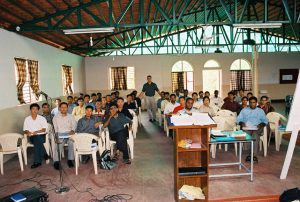
1753172-R1-039-18Five years ago, I had the privilege of teaching a History of Doctrine course to a group of 43 graduate students in India.  As I taught these young students, my heart was jolted by their commitment to Christ. In the course of 18 days, I preached, taught for 5-6 hours per day, graded work late into the night, met with students in my makeshift office, and shared tea and meals with these remarkable students. During this time, I had the chance to be both teacher and student.  

What the Teacher Learned

I had planned my last lecture especially well. In closing, I would give them the charge that they now carried the message of Christ to the world–what had been passed from Jesus to the disciples to the church planters of Acts to the elders of churches throughout the globe now came to them. It was their task to carry that same message into the world.

I barely made it through the lecture as I fought through my tears. I had learned something of the hardship they faced and the enormity of their task, and it was more than I could handle. Knowing that these 23 or 24 year old young men would likely take the message of Christ into a heavily overcrowded and poverty-stricken region where very few Christians lived was daunting. That they would most likely set up their churches in an 8 x 10 ft storefront made of cinder blocks seemed impossible. Yet, there was also hope.

1753222-R1-006-1AI was humbled as I watched G–, a student with a learning disability who had once been rejected by his family as a failure, give up cricket games to study my notes (I was told he had to read them three times in order to understand). G– scored 98% in the course (much better than I had done as a student!). One employee at the school was a wonderful fifteen year old young lady that had recently been rescued from human-trafficking as a bride-for-sale. Another student said he dreamed of turning his tribal people from head-hunters to soul-hunters, and I’m certain that he was being serious. When I witnessed the ridiculous levels of poverty in Delhi, I was undone. It honestly took me six weeks to recover (meaning that it took six weeks to become somewhat numb again to the hardship).

Sharing in the Sufferings of Jesus

1753202-R1-024-10AOne connection that gripped me was a student I’ll call M–. M– is from China, although his father is Burmese.  After pastoring 4 years as a teenager, he snuck across the border from China to Myanmar (Burma) and then into India en route to bible college and seminary. Without any stops, that was a ten-day journey on busses and trains. He acknowledged that he shouldn’t be in India because China wouldn’t give a visa for this, but this was the only way he would become trained as a pastor. He had not seen his mother, father, brothers or sisters in five years. His father died while he was away, and he received a brief phone call from a relative. He planned to return to China and pastor a house church along the China-Myanmar border amongst his people.
1753192-R1-021-9In an email to my wife, I wrote, “It is good to be here to learn from as well as to teach and encourage these young men. They truly are young men, which means that I am getting older, but it also means that the task of leading churches in these harsh areas has been left to the young, and that is a little overwhelming for me, as I think of what they will face and the fact that many of them will be forced to face it alone in a village of people hostile to all that they stand for. Gives my prayers a new sense of urgency.” I still feel that way.


A Prayer and Plea

I leave you with an excerpt from my last journal entry from India 5 years ago. May we in our luxury and comfort and silly church battles become broken for those around the world who face such difficulty in being Jesus’ disciples. May our prayers sustain them as we lift them up to our Heavenly Father. May their devotion to our Rescuer spur us on to greater love and faith and ministry.

M–, my new friend from China who travelled 10 days journey illegally to be here, came to see me today. We talked for a few minutes about ministry and he wanted some information that I will email to him. We talked for a few more minutes before I had to turn to some work that needed to get to the copier before close of work today. As our conversation ended, he looked at me and said, “You leave Friday. Tomorrow will be busy day for you. We may not talk again.” I truly thought he was going to cry. I told him that we would eat lunch together tomorrow. I can tell that it feels good to him to know that someone outside of his people knows of his plight. He loves to talk about his people and the ministry he hopes to have among his people. All of the students love to talk about the plight of their people.

Marip Tu is the student on the right

Another student gave me a book today, one that was privately printed by a secret group (he seemed nervous about giving it to me and wanted me to read it “privately” in case someone was offended by the book). It’s over 500 pages long. I leave in less than 48 hours. When in the world am I going to read that? But in a note on one of his assignments, he had mentioned that he hoped to turn his people from head-hunters to soul-hunters. I included a note that I would pray for his people later that day. Two days later, he asks me if I could read this book. I could make no promises there, but it is at my bedside tonight. The students have a great burden for “their people.” There isn’t much national pride for India, but they all dearly love “their people.” And for most, that results in sadness and spiritual burden due to the hardness of the people to the gospel.

Clearly, there will be some sorrow for me in leaving these friends, brothers and sisters. There is much work to do here, and they bear an inordinate burden for the Church. But I will be happy to be home, to be with Nan, to be with the boys. I thought today about being with my church family and longed to be a part of worshipping with them. Going home will be good, but this too has been good.

May God be lifted up in His Church, both here and there.

Jeff

 -jdl

face for blogYesterday, my facebook status generated some interesting conversation. In fact, one of my former theology professors initially balked at it, thinking it incorrect. I wasn’t trying to be provocative or say anything shocking, but it obviously caught my friend off-guard. All of this got me to thinking that I ought to expand on these thoughts a bit. I’m not sure exactly where this will go, but I’m imagining several posts dealing with the topic.


My statement: The gospel wrecks you before it restores you.

The word gospel means “good news,” so it might seem odd to speak of good news that wrecks you. Let me explain.

What I’m NOT Saying

First, I’m not saying that the gospel corrupts or destroys something good. Sin does that. In his remarkable book, Not the Way It’s Supposed to Be: A Breviary of Sin, Cornelius Plantinga, Jr. writes, “Sin has pirated from goodness — energy, imagination, persistence, creativity.” Sin always steals something good, siphoning off God’s blessing into a leaky bucket we have designed for ourselves. We nourish our lives on this pirated goodness, using our skills, talents, passion, and vision for our own enjoyment and self-promotion.

God allows us to go our own way, even if it harms us. Plantinga recalls Augustine’s idea that “sin becomes the punishment for sin.” By this he means that our destruction is in getting exactly what we want. When we are given our heart’s desire, it usually ends in our destruction. Pastor Tim Keller writes, “In the book of Romans, Saint Paul wrote that one of the worst things God can do to someone is to ‘give them over to the desires of their hearts’ (Romans 1:24)” (Counterfeit Gods, 3).

So, we continually steal goodness for ourselves and use it in ways that, although temporarily pleasurable or satisifying, are ultimately harmful. When we do this day in and day out, we develop habits of living that are almost impossible to overcome. Our self-driven ways of living become so routine and normal that we can’t imagine there is another way. Returning one more time to Plantinga, he writes, “Sin has dug in, and, like a tick, and burrows deeper when we try to remove it.” Our inability to conquer our bad habits lead us to resignation. We say things like: “this is just the way it is,” “this is how I was made,” or “there is nothing wrong with this.” Over time, we give up fighting and grow so comfortable in our sin that we hardly notice its presence anymore.

What I am Saying

When I say that “the gospel wrecks you before it restores you,” I am saying that we desperately need to experience God’s wake-up call. God sends His Spirit to arouse us from our sin-induced spiritual slumber, and the gospel is God’s alarm clock. The gospel says to us, “You are not enough.” You may say that this is technically not “the gospel,” but it is at the very least implicit in the gospel message. To say “Jesus came to save you” is to say “you are not enough.” To a life that has for years embraced the idea that Self is King, this is a shocking statement. This is how we are wrecked by the gospel. The gospel message of Jesus is so contrary to anything we’ve experienced that we are undone by it, we lose our balance, we feel unstable. Whether we are self-righteous, self-focused, self-determined, self-satisfied, self-deceived, self-pleasured or self-dependent, we must learn a new way that is not dependent on ourselves, and that is unsettling.

Believing the gospel overturns our entire way of approaching life. Redemption and resurrection are disruptions of the status quo. Self-righteousness and performance are cast aside. The false supports we’ve constructed for our lives are knocked down so that our position with God may be rebuilt. Grace wrecks our previously accepted but woefully inadequate approach to life and teaches us a new way to live by faith. Jesus said, “You must lose your life (be wrecked) in order to find it (be restored).”

We’ll further explore what this means in the next post…thanks for reading. May you be wrecked completely by the grace and the goodness and the restorative gospel of Jesus.

-jdl

I wanted to share with you three reminders that justice is worth the fight. I can’t listen to these recordings without having my soul profoundly stirred. Where justice demands our presence, may we love deeply, live boldly, pray constantly, hope vividly, act relentlessly.

The most haunting song I’ve ever heard – “Strange Fruit” by Billie Holiday.

One of the greatest speeches ever delivered – “I Have a Dream” by Martin Luther King, Jr.


In the fight against injustice, God must be real – “A Knock at Midnight” by Martin Luther King, Jr.

Seek justice ’til Jesus comes.

– jdl

masked_rider

As with most of the sports world, I’ve been sucked into the drama that has surrounded the Texas Tech football program over the last week. I won’t drift into sports reporting here, as everyone from the NY to LA is covering it, but as I’ve read several articles over the last few days, I’ve seen some things that made me want to offer a few observations that, though somewhat obvious, are still important reminders.

Leach_PirateOf course, there are the humorous and obvious lessons: Pirates like gold and have authority issues; never get involved in a West Texas turf war with people that idolize a mask-wearing rider of a black horse. Resisting the temptation to comment on coaches who are also lawyers or players with famous daddies, I’ll move on.

Five rambling observations on some things that matter in working relationships…

Trust Matters
Where trust is absent, speculation swirls. Too often, people focus on the external conflict and neglect the internal reality of a relationship. There is a presenting problem: a conflict, a review, a decision, a disagreement. It’s easier to resolve the situation of the presenting problem than it is to reconcile the relationship. However, if the relationship is not restored, there will always be another issue waiting to drive a wedge between those involved. It is important to remember that you must work harder at rebuilding trust than you do at creating formal agreements, structures and contracts.

Culture Matters
Different regions approach life in different ways. If you are going to mix it up, you’d better be willing to deal with the differences. These differences are not insurmountable, but they do require an extra commitment to be flexible and overcome the differences. This is why so many organizations are run by “good ol’ boy” networks – it’s just easier (well, that and the whole power/control thing). Diversity is a good thing and worth pursuing, but it will mean dealing with some misunderstanding and longer conversations to sort things out.

Communication Matters
Email is a bad form of communication. Sure, it serves a great purpose for transferring information in a technological world, but it often leads to misunderstanding. Unless your last name is King, Wolfe, or Rushdie, I’d assume your email won’t communicate what you want it to. If you need to discuss something that deals with emotion, humor, crisis, conflict, or people, don’t lead out with email. That piece of technology to the right of your computer is called a phone. Use it. Try the phone or a personal visit, and then send an email with details or other info as a follow-up.

Humility Matters
Pride isolates and anger divides, but humility connects and unites. Humility has a unique power to overcome differences in opinion, personality and approach. Many people think of humility as a benefit at church but a hindrance in the “real world.” Thoughtful people will recognize that humility and backbone can go together. When they do, strength emerges in a person that can work through differences and not just around them.

Timing Matters
Know when it’s time to go. We don’t like to admit it when things are no longer a good fit. I’m not sure why. Maybe we are still hurt by the sixth grade break-up with blue-eyed Susie. Maybe it feels like weakness when we can’t make things work. Usually, there is enough agreement on the goals that you feel like you ought to be able to work things out, but when things are swirling for months or even years without improvement, you are almost never going to turn the corner. When that’s the case, seek wise counsel to make sure you are seeing things accurately, and then look for an exit ramp that will allow for a healthy and graceful transition.

-jdl

I was reading in David McCullough’s fantastic biography of John Adams recently, and I ran across a section that I thought had relevance to all leaders. McCullough wrote:

At the start of every new venture of importance in his life, John Adams was invariably assailed by great doubts. It was a life pattern as distinct as any. The boy of fifteen, riding away from home to be examined for admission to Harvard, suffered a foreboding as bleak as the rain clouds overhead. The delegate to the first Continental Congress, preparing to depart for Philadelphia, felt “unalterable anxiety”; the envoy sailing for France wrote of “great diffidence in myself.” That he always succeeded in conquering these doubts did not seem to matter. In advance of each large, new challenge, the painful waves rolled in upon him once again.

Part of this was stage fright, part the consequence of an honest reckoning of his own inadequacies. Mainly it was the burden of an inordinate ability to perceive things as they were: he was apprehensive because he saw clearly how much there was to be apprehensive about.

Three Kinds of Fear that Leaders Face

McCullough mentions three fears with which Adams wrestled: (1) stage fright, (2) personal inadequacy, and (3) realistic assessment of his current leadership situation. All leaders face these same fears. While all three are present in our leadership worlds, each fear requires a different response. The first two, we need to discard; the third is something we carry with us.

Fear 1 – Stage Fright

When McCullough speaks of stage fright, he’s not talking about being “on stage.” He means the fear of the leadership mantle that must be worn as a leader in any setting. This fear comes from knowing that your leadership mettle is about to be put to the test by a new challenge, likely one which you have never faced before.

You see plenty of examples of stage fright in the Bible. I liken this fear to that of Moses. He first responded to God’s call by saying, “Who am I that I should go that I should go to Pharaoh and bring the children of Israel out of Egypt?” He clearly preferred hiding out in the comfort (wink wink) of being a shepherd to taking the stage of leadership. He was determined to dodge the frontman role.

God’s response to Moses was more or less, “Get over it.” God was gracious to him and sent Aaron to help, but which of the two had a lead role played by Charleton Heston in the movie “The Ten Commandments”? Moses. God didn’t allow Moses to skip out just because of his stage fright.

When we experience this fear, we need the same advice: get over it. God almost always gives us someone to help shoulder the weight, but a leader must repeatedly let go of fear, and move in the direction God has called him or her to go.

Fear 2 – Personal Inadequacy

The second kind of fear has more to do with “an honest reckoning of [our] own inadequacies.” Many of us are performance-based people who feel a need to succeed. We struggle against our weaknesses all the time, so we are very aware of what they are. Knowing we don’t have it all together, we spook easily.

In Jeremiah 1, we read of God’s call of the prophet Jeremiah. God makes it clear that He planned to make Jeremiah a prophet before his daddy’s sperm had a first date with mommy’s egg. Since God decided this before his DNA was set, one would think Jeremiah could be confident that God knew what He was doing. Instead, Jeremiah says, “Ah, Lord God! Behold, I do not know how to speak, for I am only a youth.” Do you see the list of personal inadequacies he just pulled out? I can’t speak. I’m too young. God replies something along these lines, “Shut up, but speak clearly when I tell you to speak.”

This fear must be faced head on and discarded as an enemy. I know this fear well. When I battle feelings of inadequacy, I have developed the spiritual discipline of praying through Jeremiah 1 as a reminder that success is determined by a lot more than my performance. God calls us, and He will use us as he chooses.

Sometimes, this argument for God’s sovereign will is used as an excuse for laziness or cowardice. This may happen if a person is placed into a leadership role but lacks the gift or the heart of a leader. If that’s the case, then there are other issues that must be dealt with. Most of the time, however, this isn’t the case. I find that most natural leaders tend to strive for excellence, usually placing too much of their significance in their success. For these leaders, casting off the fear of personal inadequacy is a call to abandon self-importance and depend on God.

Fear 3 – Leadership Situations

The third fear that every leader faces is a different kind of fear. McCullough describes this as “the burden of an inordinate ability to perceive things as they [are].” Every good leader is able to look out into the days ahead and know what’s coming. He may not see everything perfectly, but he has a sense of what is coming down the road. John Adams “was apprehensive because he saw clearly how much there was to be apprehensive about.”

Seasoned leaders are not afraid because they are uncertain of the future; they are afraid because they know what will happen in the days ahead. They know how the trials will beat them up. They know the battles that must be won. They know the pain it will cause people they care about. These are not matters to dismiss. These are realistic concerns that must be dealt with honestly and diligently and prayerfully.

We should not be shocked by difficulty, since we are instructed, “Beloved, do not be surprised at the fiery trial that comes upon you to test you, as though something strange were happening to you” (1 Peter 4:12). A primary task of a leader is to make an accurate appraisal of the challenges ahead. Jesus himself tells us that we should count the cost before we enter the work God has called us to:

For which of you, desiring to build a tower, does not first sit down and count the cost, whether he has enough to complete it? Otherwise, when he has laid a foundation and is not able to finish, all who see it begin to mock him, saying, ‘This man began to build and was not able to finish.’ Or what king, going out to encounter another king in war, will not sit down first and deliberate whether he is able with ten thousand to meet him who comes against him with twenty thousand? And if not, while the other is yet a great way off, he sends a delegation and asks for terms of peace. So therefore, any one of you who does not renounce all that he has cannot be my disciple.

You might quibble over my use of the word fear here, but the point remains: we are called to take a realistic look at the leadership situations we are entering. These may deal with an inwardly-focused church, a division in a church family, a financial crisis, a spiritual stronghold of the enemy, group injustice such as racism, callousness to sin, pride in religious service, or some other struggle. It is healthy to have a reasonable level of fear based on the challenges ahead. These “healthy” fears can drive us to seek God in our work as nothing else can.

When these fears show up, our response should be three-fold:

  1. Make a realistic assessment of the situation, and make your assessment known to your leadership team. You should not oversell the danger, but neither should you undercut the real challenges you will face. Seek input from key leaders, and adjust your conclusions as you learn new things.
  2. Do the difficult work of knowing the issues inside and out. Where I’ve made mistakes in the past, they have typically involved my emotional withdrawal from a difficult task which led to inadequate preparation—basically, I got tired, and I didn’t complete my homework.
  3. Pray. A lot. “Cast your burden on the LORD, and he will sustain you (Psalm 55:22).” God may not quickly remove the situation, but He will help us to bear the weight of it. He will also guide us as we navigate the road we are travelling: If any of you lacks wisdom, let him ask God, who gives generously to all without reproach, and it will be given him” (James 1:5).

– jdl