


I enjoy taking personality profiles and strength assessments. I find that they reenergize and refocus me. They clarify for me the things that I should invest my energy in, and they help me say no to other things. This is quick post to introduce you to a new book and to highlight a helpful point that brings some clarity to pursuing your personal uniqueness while fulfilling Jesus’ call to die to self.
 I recently read Stand Out: Find Your Edge, Win at Work by Marcus Buckingham. Buckingham became well known in the business community with the publication of his book Now, Discover Your Strengths and the accompanying StrengthsFinder assessment. His goal in that work was to help people find out what they are good at and learn to operate in those areas of strength. Instead of fighting to overcome your weaknesses (which you will always struggle to do), you should focus on developing your strengths. His main idea is that you will work harder at things you do well than at things you do poorly.
Buckingham describes StandOut in this 2 minute video.
His new book extends that focus by helping you figure out how to put your strengths to work. It includes an access code to the online StandOut Strengths Assessment. The Assessment reveals your “strengthsroles” – the roles where you can best leverage your strengths for impact. He offers the following nine strengths roles:
- Advisor
- Connector
- Creator
- Equalizer
- Influencer
- Pioneer
- Provider
- Stimulator
- Teacher
For example, my results showed that I am a Connector – Pioneer. That means that I’m good at launching things. I love to imagine a better world and get a group of gifted people together to try and do something to make a difference. While I’m struggling a bit to understand how it connects with my creative endeavors, I think that the description is about right. These things happen naturally for me, and I find myself doing this visioning/connecting/engaging work in whatever group I’m working in.
If you are new to assessments, this isn’t a bad place to start. If you’ve taken multiple assessments, StandOut will help refresh or refine your understanding of who God made you to be. Nothing radical or revolutionary here, but a helpful tool to put in your toolbox.
I sometimes hear Christians shun personality or strengths tests because they feel they focus too much on us and our happiness. While I understand what they are getting at, I think that they are missing the point. Buckingham makes a statement in the book that I think is important for us to consider:
To be truly your best, it isn’t sufficient merely to understand that you’re unique or even to understand what makes you unique. Sustained success come only when you take what’s unique about you and figure out how to make it useful… Your strengths, in essence, are value neutral. They can be put to good use, or they can…be put to bad use.
I think this statement points us in the right direction. Our uniqueness is undeniable. I think we know this practically, but I think it’s true biblically as well. The God who fit us together in the womb, who ordained our arrival in this world, who meticulously counts the numbers of our brown, blond or greying hairs, who gives us gifts and talents, who redeems our hurts and brokenness, who calls us friends certainly knows that I am not exactly like you. We are each one of us unique.
Spiritually-minded leaders will recognize that our uniqueness can be used for our personal glory or for God’s glory. When Jesus calls us to die to self, he’s not saying “stop being who you were created to be.” He’s saying something more like “Stop using who you are for selfish purposes and learn to use who you are for kingdom purposes.” This is the redemptive and transformative work of the gospel in us. We are saved from our self-focused life and saved for a God-directed life.
One of the guiding rules of my life is the belief that our deep and forever joy comes from leveraging all of who we are to honor God and extend his glory in the world. Because of this, I enjoy learning from all kind of resources that help me to develop as a person and as a leader. StandOut is another resource to help me along that path.
Do you know your greatest gifts, strengths, and roles? How has this knowledge helped you be more effective?
-jdl

 “Then the prophecies of the old songs have turned out to be true, after a fashion!” said Bilbo.

 Five years ago, I had the privilege of teaching a History of Doctrine course to a group of 43 graduate students in India. As I taught these young students, my heart was jolted by their commitment to Christ. In the course of 18 days, I preached, taught for 5-6 hours per day, graded work late into the night, met with students in my makeshift office, and shared tea and meals with these remarkable students. During this time, I had the chance to be both teacher and student.
  I was humbled as I watched G–, a student with a learning disability who had once been rejected by his family as a failure, give up cricket games to study my notes (I was told he had to read them three times in order to understand). G– scored 98% in the course (much better than I had done as a student!). One employee at the school was a wonderful fifteen year old young lady that had recently been rescued from human-trafficking as a bride-for-sale. Another student said he dreamed of turning his tribal people from head-hunters to soul-hunters, and I’m certain that he was being serious. When I witnessed the ridiculous levels of poverty in Delhi, I was undone. It honestly took me six weeks to recover (meaning that it took six weeks to become somewhat numb again to the hardship).
 One connection that gripped me was a student I’ll call M–. M– is from China, although his father is Burmese. After pastoring 4 years as a teenager, he snuck across the border from China to Myanmar (Burma) and then into India en route to bible college and seminary. Without any stops, that was a ten-day journey on busses and trains. He acknowledged that he shouldn’t be in India because China wouldn’t give a visa for this, but this was the only way he would become trained as a pastor. He had not seen his mother, father, brothers or sisters in five years. His father died while he was away, and he received a brief phone call from a relative. He planned to return to China and pastor a house church along the China-Myanmar border amongst his people.
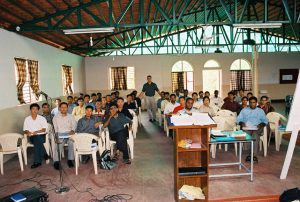 In an email to my wife, I wrote, “It is good to be here to learn from as well as to teach and encourage these young men. They truly are young men, which means that I am getting older, but it also means that the task of leading churches in these harsh areas has been left to the young, and that is a little overwhelming for me, as I think of what they will face and the fact that many of them will be forced to face it alone in a village of people hostile to all that they stand for. Gives my prayers a new sense of urgency.” I still feel that way.
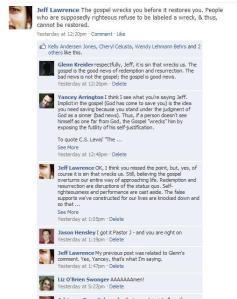 Yesterday, my facebook status generated some interesting conversation. In fact, one of my former theology professors initially balked at it, thinking it incorrect. I wasn’t trying to be provocative or say anything shocking, but it obviously caught my friend off-guard. All of this got me to thinking that I ought to expand on these thoughts a bit. I’m not sure exactly where this will go, but I’m imagining several posts dealing with the topic.


 Jeff D. Lawrence ⎮ Blog