
Archives For November 30, 1999

AN OPEN-ENDED “FOLLOW ME”

November 11, 2011 — 1 Comment

If we knew up front everything Jesus meant when he said “follow me,” we probably would have run away.

Imagine, for example, if Jesus had spelled everything out to Peter when he offered the “How to Become My Disciple” sales pitch: “Peter, here’s what I have in mind for you. You can follow me, and all of this will come true: I will accuse you of being Satan; I will announce your failures in advance to all your colleagues; I will ask you to stay awake with me during sleepless nights of blood-producing work; I will have a team member confront your ineptitude and record it for all to see as a part of your permanent public record; eventually I will ask you to give up your life in excruciating death to demonstrate your loyalty to our mission. So, Peter, how about it? Are you in?” If I’m Peter, I’m politely declining and throwing my nets into the water on the other side of the boat.

But Jesus doesn’t spell it all out for us. He just says, “Follow me.” If this were a job offer, it would feel more than a little vague. But Peter, and many more, followed Jesus anyway.

In theological terms, we speak of irresistible grace as God’s call on us and His influence in our hearts to make us something new. We choose to follow Jesus, but we would not do so unless God reached into our hearts and got to work. I think we need irresistible grace because irresistible trials do not exist. I can easily resist a trial or test. These are difficult struggles, and I avoid them whenever I can. Trials are to be endured when necessary, but never sought out. People that seek out trials are usually in need of medication.

When especially tough trials come my way, it can feel like Jesus didn’t adhere to industry standards or best practices for honesty in recruitment.  In these moments, I think, “Jesus, this is not the plan that I thought we had worked out together.” But I’m growing to see it differently.

An Open-Ended Commitment

Jesus gives a simple “follow me” as both an invitation and a command. It’s a command, because he is our king who has come to lead. It’s an invitation, because he is our Rescuer who has come to save. This invitation-command is open-ended. He does not tell us where we are going. It’s not a follow me from Point A to Point B on the map. The invitation-command to “follow me” carries an implied meaning of follow me (wherever I go). When we respond positively to Jesus’ call, as Peter did, we stand ready to follow Jesus anywhere. So, our commitment to follow is also open-ended. We aren’t certain of where the path leads. We just know that we’ve committed to go.

In this sense, it’s like marriage. When people get married, they commit to be together. They stand up in front of friends and family and make vows to one another saying “for better or worse, for richer or poorer, in sickness and in health.” These are open-ended commitments. We are promising to remain faithful no matter what. But let’s be honest. How many young couples have any idea what they are committing to when they make these promises? I love my wife and have a wonderful marriage. But the truth is that, when we married, Nan had no idea what the “worse” parts of my life would be. We said for richer or poorer, but we only imagined the richer. When she said “in sickness and in health,” she had no idea that one day we’d have three kids under the age of four when I had surgery and could not walk or drive for two months. We make bold statements of unconditional love on our wedding day, but the fullest understanding and deepest joy of those commitments comes only through many years of experiencing life together.

In the same way, we come to understand more deeply what following Jesus means through the experiences of life. Wisely, Jesus doesn’t detail every hardship up front. He simply bids us come, and then he gives us grace that carries us day-by-day. Our job is to follow him in what is right in front of us.

Open-ended commitments can be scary. Would you sign a contract to buy a house with an open blank on the line for sales price? Of course not. We have been taught to negotiate contracts to make sure there are no surprises. This is what makes open-ended commitments so frightening: you can’t negotiate the unknown.

A Relational Commitment

This is also what makes all open-ended commitments relational at their core. You can’t be sure of what lies ahead, but you can make sure you know who you are with. This is why the one who says, “Follow me,” also says, “I am with you always.” We have confidence for the road ahead because we know Jesus goes with us. When we begin to see this, our journey becomes less about the road ahead more about the companion at our side.

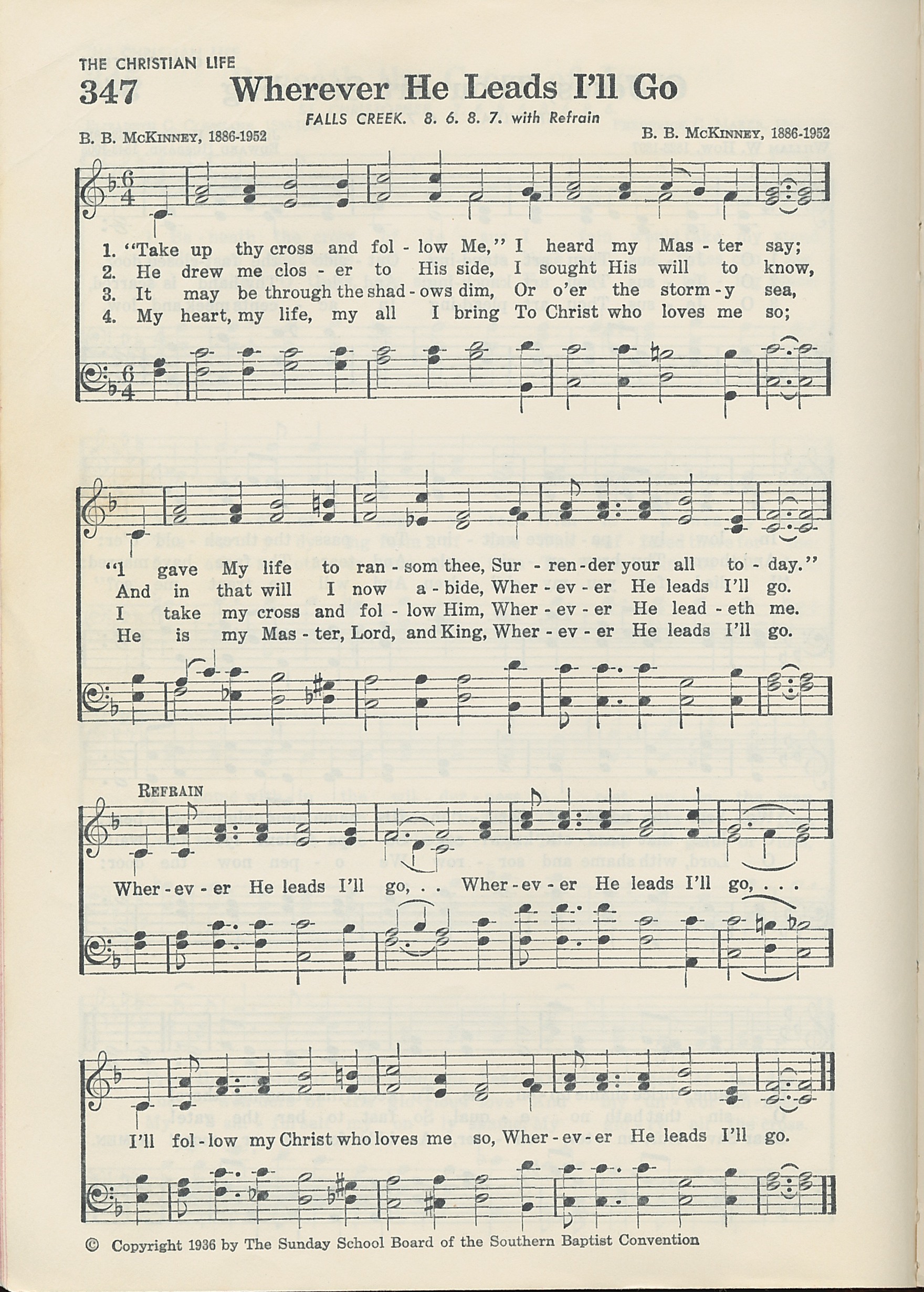
Growing up, we used to sing: “Wherever he leads, I’ll go.” Ultimately, that’s the commitment we make when we decide to follow Jesus. I copied below the page out of my grandmother’s old hymnal. The song still works.

Can you honestly sing (or say) the words to “Wherever He Leads I’ll Go”? Is there anything that causes you to hesitate or doubt?
-jdl


I recently had the privilege to watch a wonderful documentary: Waste Land. It’s a beautiful film that stirred my soul with both sorrow and hope. I want to tell you about the movie and then offer some thoughts about its message.

Waste Land was directed by Lucy Walker with soundtrack by Moby. It received an Academy Award Nomination in 2011 for Best Documentary Feature.

The film follows the journey of Brazilian born contemporary artist Vik Muniz to Jardim Gramacho, the world’s largest landfill located just outside of Rio de Janeiro. Here we meet an array of characters called catadores, the “pickers” of recyclable materials who sell their goods for profit in order to survive. We enter the stories of these men and women who crack jokes, quote Machiavelli, pass along proverbial wisdom, and generally put a good face on their existence in the dump.

Muniz recruits several “pickers” to help him create works of art by beautifully shaping the trash from the landfill into images of the broken people who work there. These inspiring “self-portraits” (the pickers are in a sense painting themselves) are a perfect collision of dignity and despair. Art made from trash. Something good from something broken. The images themselves are magnificent, and so is the message–there are no “throwaways.”

The creation of these works of art reminds the catadores that they are of great value. As the art of their own faces comes into view, they begin to open up.  They share more honestly about the struggles and pain of their lives, but they also see more clearly the nobility of their lives. This juxtaposition gives the film its power. The irony of the title, Waste Land, is in full view here. Out of supposed waste, beauty emerges.

Beyond Waste Land

What I love about Waste Land is the reminder that humanity is beautiful. In all of the pain and pleasure, sadness and joy, evil and goodness of human lives, God has placed an inherent value in us that cannot be overlooked for long. We are the stuff of novels and paintings and songs and poems and food and dance and laughter.

Followers of Jesus know why this is true. God has set eternity in our hearts, and at some level we remember what we were created to be. When we experience a work of art that is true and beautiful, it awakens in us a memory of how things ought to be. It makes us mourn a world where things are broken and long for a world where all things are whole again. Too often, we turn down the volume of this proclamation, but a faint echo summons us to remember our Creator and to long for our redemption.

When we experience works of artistic beauty, portraits of human nobility, signs of grace and redemption, we should look beyond these to the one who made them. God has placed hints of himself in the world to be pursued. Like bread crumbs on the road, not dropped by accident, they serve a purpose to lead us to God.

The Bible says that we humans bear the image of God. The day he made us, God himself said that humanity was “very good.” He puts his fingerprints on each of us. Our Creator dreamed us up as his special creation and has chosen us to carry his glory in the world. Even in our sin-tainted state, we are noble. Evil has defaced the image of God in us, but it has not been erased. It is this mark of God the Creator on us that gives us a dignity that cannot be taken away. Humanity’s greatest stamp of approval is the incarnation of Jesus, who being eternal God also took on flesh and became one of us. Nothing could speak more loudly of the significance of human life.

This truth has huge implications for all people, but it ought to especially instruct us about our care for the poor, the forgotten, the abused, the unborn, the disabled, the suffering. They too bear the imprint of God. Even the people that our cruel world casts off as trash are God’s glorious creation. There is a dignity in every human life that is worthy of our love.

But there is also a potential danger in speaking of the glory of our humanity. We might be tempted to worship ourselves as the ultimate source of dignity and beauty. At one point in the film, after the auction of his painting nets a huge sum, Tiaõ says, “God was so good to me, so wonderful.” Vik Muniz, the artist, interrupts him and says, “You’re the strong one. You are the one who is doing everything.” Whether intended or not, God is excluded from the conversation, and Tiaõ himself is seen as the ultimate strength and beauty. Now, I do not know anything of Mr. Muniz’s spirituality, so I do not intend this as a statement about his faith or lack of faith. But I think the passing comment highlights a temptation for us. Muniz’s remark cuts off the pursuit of beauty before it reaches its ultimate end. It stops short of its goal. It effectively says, “Let’s honor the beauty of humanity, but let’s not ask where that beauty originates.”

If, however, we fail to pursue this beauty beyond ourselves, we deny the full power of art. Just as the beauty of a work of art directs us to the artist, so the beauty of humanity directs us to the Creator. In this sense, I believe Vik Muniz likely has a sense of what I mean, but he fails to follow the logic all the way through. In the film, Muniz does not praise himself or his work, but he allows the people and the works of art to speak for him. He knows that art reflects the artist; the beauty of his artwork points people to his skill as an artist. Since that is true, would it not seem wise to allow the beauty of humanity on the whole to point us to the ultimate Artist?

One of my favorite lines in the documentary deals with our sense of perspective. Muniz looks out over the unending slums and shanties and buildings of Rio de Janeiro and observes, “They are not pretty places except when you look from far away.” It is a poignant comment that is also true of the portraits he is creating from recyclable trash. I couldn’t help but think that perhaps we should try to see our world from even further away. From God’s perspective, there is greater beauty in our world than we can imagine in the midst of it.

The Gospel says that humanity was broken and discarded on the trash heap of life, but Jesus came to rescue and restore us. He redeems us, gives us a new perspective, and fills us with a new hope. In Jesus, we discover that we are a part of a living and cosmic work of art. The Scripture says that “we are his workmanship,” and he is forming us into something wonderful. It is Jesus, not us, that finally transforms our lives into something wonderful. Our ultimate nobility and beauty comes as Jesus creates and recreates until we experience a new heavens and a new earth where joy and peace rule forever.

The most powerful line in Waste Land occurs when Tiaõ looks at the beauty of his completed portrait and says, “I never imagined I’d become a work of art.” The statement reveals a fantastic combination of humility and glory. It is as though Tiaõ realizes his smallness and his greatness in the same moment.

Perhaps followers of Jesus have something to learn from this. The Gospel says that God is making broken and sinful people into a new and beautiful work of art. Because of this, we should live with a constant sense of humility and glory, smallness and greatness, brokenness and beauty. This is the art of God’s grace on the canvas of the universe.

Is it easy for you to lose sight of the beauty and dignity of human life? How would it impact you if could gain a new perspective and see your life as a part of God’s cosmic work of art?

-jdl

All photo and artwork rights and credit to Waste Land or Vik Muniz at the following:

I ran across a verse this morning in my Bible reading that grabbed my heart and hasn’t let go all day. Isaiah 30:18 says:

The Lord waits to be gracious to you, and he exalts himself to show mercy to you.

It caused me to reflect on things that keep me (and you) away from God.

  • We stay away because we think we are too sinful, and we stay away because we don’t realize how sinful we are.
  • We stay away because we have not achieved enough, and we stay away because we have achieved so much.
  • We stay away because we are insecure in our failure, and we stay away because we are secure in our success.
  • We stay away because we are lonely, and we stay away because we are surrounded by people.
  • We stay away because we are insignificant, and we stay away because we are significant.
  • We stay away because of our self-doubt, and we stay away because of our self-confidence.
  • We stay away because of weakness and strength, sorrow and joy, shame and glory.

All these things keep us away from God. Needlessly. The Gospel says that nothing stands in our way; Jesus has taken it all.

Whatever it is that keeps you away…let it go. Now.

Let nothing keep you away from Jesus.

He waits to be gracious to you. He stands at attention in his readiness to show mercy to you. 

Let nothing keep you away.

-jdl

I enjoy taking personality profiles and strength assessments. I find that they reenergize and refocus me. They clarify for me the things that I should invest my energy in, and they help me say no to other things. This is quick post to introduce you to a new book and to highlight a helpful point that brings some clarity to pursuing your personal uniqueness while fulfilling Jesus’ call to die to self.

I recently read Stand Out: Find Your Edge, Win at Work by Marcus Buckingham. Buckingham became well known in the business community with the publication of his book Now, Discover Your Strengths and the accompanying StrengthsFinder assessment. His goal in that work was to help people find out what they are good at and learn to operate in those areas of strength. Instead of fighting to overcome your weaknesses (which you will always struggle to do), you should focus on developing your strengths. His main idea is that you will work harder at things you do well than at things you do poorly.

Buckingham describes StandOut in this 2 minute video.

His new book extends that focus by helping you figure out how to put your strengths to work. It includes an access code to the online StandOut Strengths Assessment. The Assessment reveals your “strengthsroles” – the roles where you can best leverage your strengths for impact. He offers the following nine strengths roles:

  1. Advisor
  2. Connector
  3. Creator
  4. Equalizer
  5. Influencer
  6. Pioneer
  7. Provider
  8. Stimulator
  9. Teacher

For example, my results showed that I am a Connector – Pioneer. That means that I’m good at launching things. I love to imagine a better world and get a group of gifted people together to try and do something to make a difference. While I’m struggling a bit to understand how it connects with my creative endeavors, I think that the description is about right. These things happen naturally for me, and I find myself doing this visioning/connecting/engaging work in whatever group I’m working in.

If you are new to assessments, this isn’t a bad place to start. If you’ve taken multiple assessments, StandOut will help refresh or refine your understanding of who God made you to be. Nothing radical or revolutionary here, but a helpful tool to put in your toolbox.

I sometimes hear Christians shun personality or strengths tests because they feel they focus too much on us and our happiness. While I understand what they are getting at, I think that they are missing the point. Buckingham makes a statement in the book that I think is important for us to consider:

To be truly your best, it isn’t sufficient merely to understand that you’re unique or even to understand what makes you unique. Sustained success come only when you take what’s unique about you and figure out how to make it useful… Your strengths, in essence, are value neutral. They can be put to good use, or they can…be put to bad use.

I think this statement points us in the right direction. Our uniqueness is undeniable. I think we know this practically, but I think it’s true biblically as well. The God who fit us together in the womb, who ordained our arrival in this world, who meticulously counts the numbers of our brown, blond or greying hairs, who gives us gifts and talents, who redeems our hurts and brokenness, who calls us friends certainly knows that I am not exactly like you. We are each one of us unique.

Spiritually-minded leaders will recognize that our uniqueness can be used for our personal glory or for God’s glory. When Jesus calls us to die to self, he’s not saying “stop being who you were created to be.” He’s saying something more like “Stop using who you are for selfish purposes and learn to use who you are for kingdom purposes.” This is the redemptive and transformative work of the gospel in us. We are saved from our self-focused life and saved for a God-directed life.

One of the guiding rules of my life is the belief that our deep and forever joy comes from leveraging all of who we are to honor God and extend his glory in the world. Because of this, I enjoy learning from all kind of resources that help me to develop as a person and as a leader. StandOut is another resource to help me along that path.

Do you know your greatest gifts, strengths, and roles? How has this knowledge helped you be more effective?

-jdl

WHEREVER YOU GO

July 15, 2011 — 7 Comments

I visited a friend yesterday who is dying of cancer. Just in case you are wondering, cancer sucks, but it will one day be defeated. That day has not yet come. It was good to be with my friend. We talked about his memorial service — what songs and scriptures might be used. We talked about catching large mouth bass on Santee Cooper Lakes in South Carolina. His wife and I ungracefully moved an over-sized recliner down a narrow staircase so that he’d have a more comfortable place to rest. We read the Bible. We circled up and grabbed hands to pray with his family and a hospice nurse. We talked about what lies ahead. We spoke of faith that is sometimes small and a God who is always big.

It was good to share in the struggle of my friend, and to remind him that God never leaves us, never abandons us. God is here, even when things are rough. It was good to remind myself as well.

Are you facing a trial that requires faith? Maybe your trial is a disobedient child that is running from Jesus. Maybe its a life transition that you didn’t want. Or, like my friend, maybe you are approaching the final trial of staring at death through eyes that know life is short. Whatever you face, God is with you, and God is for you.

Life moves like a wild roller-coaster ride of ups and downs and unexpected turns. As you approach the next corner unable to see what’s ahead, you can rest in the reality that God is overseeing the ride.

In the midst of trials, it is good for the soul to dwell on God’s promises. I thought I’d share a few with you. In my prayer and bible reading this week, I spent some good time reflecting on this verse:

You keep him in perfect peace whose mind is stayed on you, because he trusts in you. Trust in the Lord forever, for the Lord God is an everlasting rock. (Isaiah 26:3-4)

We’ve been memorizing this verse with my children:

Be strong and courageous. Do not be frightened, and do not give up, for the Lord your God is with you wherever you go. (Joshua 1:9)

What verses of scripture do you look to when you are facing a trial?

-jdl

If your life is like mine, the Easter season is very busy. Our days are consumed by an all-hands-on-deck time of planning special worship services and additional outreach efforts. You stack this on top of the probable heavy load of family responsibilities, counseling needs, leadership issues and other burdens that are typical for pastors. This is Superbowl week for churches, and we want to make the most of our opportunity. I don’t know of any pastor that is spending this week melting into the sofa watching lacrosse on ESPN12, playing Angry Birds and downing multiple bags of 1st Degree Burn Blazin Jalapeno Flavored Doritos.

As busy as we are, we need to remember, especially at Easter, that we have a holy calling for which we need holy preparation. It is easy to devote more energy to preparing song lists and sermon slides than we devote to preparing our souls. But before we can pour ourselves out in service, we must fill ourselves up with the love of God.

I find a good reminder of both our call and our preparation in the short letter of Jude.

The pastors’ call (what a daunting task!): “have mercy on those who doubt, save others by snatching them out of the fire; to others show mercy w/ fear, hating even the garment stained by the flesh” (Jude vs22-23).

The pastors’ preparation (what a blessed provision!): “build yourselves up in your most holy faith; pray in Holy Spirit; keep yourselves in the love of God” (Jude vs20-21).

We need both. To enjoy the benefits of holy preparation w/out faithfulness to your holy calling is selfishness. To attempt your holy calling without holy preparation is foolishness. You cannot have one without the other.

So, I’m preparing my soul for Easter. In the hurried days, I’m trying to be still at different times throughout the day to preach to myself, or just to let the beauty of Jesus death and resurrection sink a little deeper into my heart. And I’m trying to find one elongated time of silence and prayer so that I can feel the pain of the bloody cross and experience the joy of the empty tomb.

As I walk into the greatest event of the year, here is my prayer: may I feel the passion and weight of holy calling more fully than ever before, and may I experience the blessing and encouragement of holy preparation more deeply than I imagined possible. I need both.

Pastor, do you feel like you get lost in all the planning for Easter? What do you do to help nourish your soul in this season?

-jdl

How Important are YOU?

February 22, 2011 — Leave a comment

One of the great and humbling realities that followers of Jesus experience is this: God uses you. In his sovereign and eternal plan, God decided to bring about divine good in the world through broken people.

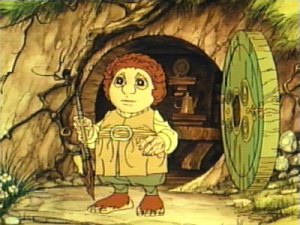
As a pastor, I see many people (myself included) who drift in one of two wrong-headed directions related to their importance to God’s plan. I recently ran across this passage from J.R.R.  Tolkien’s The Hobbit, which powerfully captures this tension:

h-1-0126-bilbo-baggins“Then the prophecies of the old songs have turned out to be true, after a fashion!” said Bilbo.

“Of course!” said Gandalf. “And why should not they prove true? Surely you don’t disbelieve the prophecies, because you had a hand in bringing them about yourself.”

“You don’t really suppose, do you, that all your adventures and escapes were managed by mere luck, just for your sole benefit? You are a very fine person, Mr. Baggins, and I am very fond of you; but you are only quite a little fellow in a wide world after all!”

– J. R. R. Tolkien, The Hobbit
(quoted in Dallas Willard’s The Divine Conspiracy)

DON’T UNDERESTIMATE  YOUR IMPORTANCE

We, like Bilbo, may underestimate our importance. Bilbo was obviously aware of all that had happened on his journey, but he had a difficult time believing that he was the one being used to carry out ancient prophecies. Some of us need to comprehend the great honor we have to continue the noble fight of faith and further the long-promised mission of Jesus’ kingdom. You are a part of something greater than your life.

DON’T OVERESTIMATE YOUR IMPORTANCE

On the other hand, we may overestimate our importance. Bilbo had taken on each adventure and survived to tell his story, and he found it tempting to think that the story was his own. Gandalf’s reminder is good for all of us: in the grand adventure, you are very small and you had magical and mysterious help along the way.

The Gospel keeps us from either extreme. We cannot doubt our personal value: Jesus died for us and sent us on a mission. Neither can we depend upon our personal value: it is a generous grace that we get to play a part at all, and the story is certainly about someone of much greater worth.

Live courageously, serve humbly. And never under- or overestimate your importance.

What’s your story? Are you more tempted to overestimate your importance or underestimate it? What helps keep you balanced between the two?

-jdl

Finding Compañeros

July 21, 2010 — 6 Comments

COMPANEROSI recently read Lonesome Dove, Larry McMurtry’s Pulitzer Prize winning novel made famous by the television miniseries many consider the greatest ever (starring Tommy Lee Jones and Robert Duvall). McMurtry’s story follows a group of men on a cattle drive from Mexico to Montana. In many ways, the book is about men, their internal drives or passions, and the friendships they share along the way. This motley group assembled over time, but the core of the group served as Texas Rangers during the days when they fought real battles throughout the region. Through many eventful, often difficult, years together, the men had become “compañeros.”  These relationships weren’t perfect, but they were characterized by intense loyalty, sacrifice, honesty, and memories. Every guy needs relationships like these, but few have them.
As I’ve observed guys who become real compañeros, I’ve discovered four things that create movement toward meaningful relationships: props, plans, risks, and laughs.

GUYS NEED PROPS

Women seem to get together with other women and start talking deeply without effort, but guys aren’t like that. You put them together and all you get is something along the lines of “how’s work?” or “you playing fantasy football again this year?” Those two conversations can fill an entire evening.

In general, guys don’t talk openly and freely without an external prop. It may be a task, a mission, a hobby, a shared history or some other event that brings them together. Men become close on a three-thousand mile cattle drive. They open up during a long winter in the trenches of wartime. They are brought together by an adventurous road trip. It isn’t always something grand. It may be something as simple as a regular hunting trip, a golf foursome or mission trip. It may be group of friends from your college dorm or a church small group. There is not any “magic” prop, but there is almost always some kind of prop that brings the guys together initially.

My group of friends and I came together as friends during college, but those friendships expanded through a college road trip to bury a “time capsule” on the Texas-Mexico border (modeled loosely on the movie, “Fandango”). We each included something of great personal value and a list of spiritual commitments and life goals in the bottle. Ten years later, we returned to dig it up. That event become an annual long weekend together that has become a highlight in our lives.

If you want to find real friends, I suggest you grab a group of guys and initiate some unique activity. In male relationships, activity opens the door for conversation. Men start talking deeply after they’ve worn themselves out, made fun of one another or blown something up in a bonfire.

GUYS NEED PLANS

Past performance does not guarantee future success. Just because some prop brought you together for a unique time of relating as friends, you may not continue in that kind of friendship in the years ahead. Most guys who have not found life-long compañeros reflect on certain friendships with a nostalgic longing to go back, maybe even with a tinge of sadness. They are sweet memories, but they are just that: memories of something good that once was but is now gone. Friends rarely intend to lose touch with one another. If your experiences together are going to grow into deep, lasting relationships, you need to commit to a plan.

With my group, we decided to take an annual trip together. We pick a destination and a date, and we all fly in for a long weekend each year. My “Fandango” trip with this group of 6 men helps me hit my annual laugh quota in single weekend. This takes a real commitment, but it’s worth everything it takes to make it happen. Our wives sacrifice on the home front to allow us to go. We take time off work. We split the costs evenly to make it fair (sometimes, we pick up the tab for one another when finances are tight). This commitment propelled us from being college friends to becoming life-long friends.

The bottom line is that you won’t become compañeros without regular time to laugh, play, and goof off together. This usually takes one person in the group who initiates an ongoing plan for being together and gets a commitment from the group. A plan creates a path for deepening relationships as you journey through the ups and downs of life together.

Most of the time, a particular place or activity becomes a big part of the group’s identity. Guys seem to have a desire for a tradition that makes this time special. As men move from the free-wheeling college years to the responsibility of their 30s and 40s, they need time “away” from the normal routine of life. I’d encourage you to try something that allows for a break from your normal responsibilities and demands some real commitment from one another.

GUYS NEED RISKS

The third element I see is risk. If there is no risk, you will settle into a cycle of conversation that repeats itself over and over without taking you anywhere. Think about your relationships with your father or brother or co-workers for a minute. I bet you could write a script for most those conversations as they revolve around the same topics with each phone call. This is just what guys do. We are strange beings. We privately long for a deeper relationship but we almost never acknowledge it.

Friends must continually take risks by sharing life at a vulnerable level. It amazes me how risky it feels to share what is happening in my heart even with my most trusted friends. We’ve been sharing life together for twenty years, but it still feels threatening to let them see my hurts, my unhealthy desires, my anger, my dreams, and my joys. It also brings freedom. The more I share, the more I’m freed up to be myself around them.

Most groups need a guy with the guts to be honest in front of others. Sometimes, it means saying, “You know what guys? I struggle with ______.” Or, “You know what hacks me off about my life right now? It’s ______.” In our group, it seems to be a different guy who leads out each year with an honest and bold statement about his life. Each time someone opens the door to his heart, I think to myself, “OK, here we go.” It’s become my favorite part of our trip. I find out that I’m not that weird, or maybe that I’m just as weird as everyone else. Somehow, that’s one of the things guys need to know: we are all jacked up. That kind of vulnerable sharing is relational fuel for men. Like a car, you have to refill the vulnerability tank regularly or the friendship runs out of gas.

GUYS NEED LAUGHS

With men, laughter both precedes and follows relational risks. Guys need to laugh, and I’ve found that guys won’t share openly until they have laughed freely. If you want guys to open up, you’d better crack one another up first. Some men don’t know how to laugh. Because of this, people will rarely feel comfortable enough around them to be honest about what’s in their hearts. Be careful sharing too much of yourself with men that can’t laugh. The other side of this is that men who have shared openly laugh even harder. The trust and confidence gained in deep relationships lead to uncontrollable laughs that roll out until they bring tears.

For guys, friendship never happens as spontaneously as we’d like. It takes props, plans and risks, but the investment leads to a kind of laughter that is only shared by true compañeros.

-jdl

When the Apostle Paul was planting churches in the first century, he wrote a letter to a church-planting partner named Titus. He wanted to make sure Titus had not been distracted from first-order business in the church. In the letter, he wrote, “This is why I left you in Crete, so that you might put what remained in order, and appoint elders in every town as I directed you.”

Global-mission-of-GodThree quick observations help us learn something about the appointment of elders in church plants.

First, there was something that remained undone in the preparation of the church until elders had been put in place. This was not optional, supplemental or secondary. The local churches were incomplete until they had God-ordained leaders.

Second, there was period of time that passed from when these churches were launched and when the elders were in place. Presumably, this allowed time for church health, spiritual growth, character evaluation, doctrinal training, and missional living to develop within the people. We are not told what period of time passed before the establishment of elders in each church, but it is clear that a period of leadership transition is normal for most church plants.

Third, Paul (the visionary leader for the church planting movement) designated a trusted leader named Titus (a regional pastor) to appoint elders for the churches. Paul writes to Titus: “This is why I left you in Crete…” It was a priority for Paul and for Titus in the launching of new churches. Most church plants follow the pattern of a leader or leaders, often from outside the core group, who oversee the church until elders have been raised up from within the new church.

The Global Movement of God

When you step back and look at the big picture, this pattern makes sense. A church is not a stand-alone organization designed for its own good. A church is a part of The Church, a global movement of God to replicate the life and mission of Jesus in people of every tribe. The movement strategy is to launch new local churches that will reproduce authentic Christ-followers in every people group. For the movement to reach its full potential, each new church must join in the global multiplication of churches.

If a new church is indeed part of this global movement, it is clear that establishing healthy leadership in each church is essential to success of the movement as a whole. It is also clear that the elders of the local church should see themselves as leaders in a movement that extends far beyond their local community. They are a team of leaders on assignment in a local church to further reproduce the life and mission of Jesus in a specific place, with the purpose of furthering the global mission of God.

Churches often lose sight of their role in the global mission of God, and a new church struggling to reach the lost, update the website, pay the bills, and survive the next Sunday is especially vulnerable at this point. It takes just a few people to distract or derail a church in its early years. This is why transitional leaders must guard the gate closely and prioritize the training and appointing of elders in a church plant. This is also why the initial elders must understand and embrace their role in God’s movement called The Church. The first elders in a church bear a great burden to keep a rapidly-changing and often immature church on course so that it can maximize its redemptive potential in the world.

-jdl

We launched our church because of the great need in our area for churches with both deep belief in the gospel of Jesus and deep love for the people in our area. Rather than retreating from our world, we wanted to be a church that engaged our world for good. It is hard to deny that the South is littered with the bones of dead or dying churches that are failing to positively and significantly impact our world for Jesus. That’s not to say that every church is a bad church, but it does point to some major issues at play in many churches. Two years into our church plant, I am more convinced than ever of the need for new and renewed churches to meet the challange of a rapidly changing culture. Statistics also bear this out (see the map below). For the first time in 200 years, the church in the South is on the decline by attendance.

April 26-27, I will be attending a conference that will address these issues and call us to make a difference at this critical time. I want to invite you to join me at the conference. It would be a blast to have a bunch of us dreaming and praying together about how God might use us to engage our world with the gospel. If you are interested, you can register at www.advancethechurch.com. Please let me know, and we’ll plan to connect.

     ———————

The following was posted on Pastor J. D. Greear’s blog (jdgreear.com) and is reprinted by permission.
Guest Blogger:
Mike McDaniel, Director of SendRDU
Map Source: American Church in Crisis by Dave Olsen

That’s the title for this year’s Advance Conference, April 26-27 in RDU. Last year we called for a resurgence of the local church. This year we’re focusing on the major issues that are standing in the way of that happening here in the South.

The South is changing. Urbanization and the vibrant growth of our cities have transformed the cultural landscape. Cities like RDU have become new centers of business and education, places where culture is being formed and made. And yet as our cities are advancing, the church is shrinking. For the first time in its history, the church in the South is declining at a rate faster than anywhere else in the country.

See for yourself. This map shows you where evangelical Christianity is growing in the U.S. (Pink indicates growth. Blue indicates decline).

Serviceu_header

And this isn’t just a problem in the cities, either. These changes are felt in small towns, where small town southern values are clashing with new urban postmodernity, and religion is often more prevalent than the gospel. There may be churches on every corner, but most are plateaued or declining to the point where they will be empty in 20 years.

As we stand at this critical turning point, we must be prepared to respond. We believe that the decline of the church is not due to external factors, but internal failures of the church to faithfully communicate the Gospel and engage the changing culture around us. That is the vision behind the title Contextualizing the Gospel in the New South. We want to equip pastors, lay leaders, and members to respond by engaging the changing culture of the South with the unchanging message of the gospel.

This year we’ve moved the conference to the Summit to be able to offer it the cheapest price possible. Right NOW you can get tickets for a ridiculously cheap early bird rate of $50.

Speakers include: Mark Driscoll, Ed Stetzer, Johnny Hunt, David Platt, Tullian Tchividjian, Matt Carter

You can register at www.advancethechurch.com.