



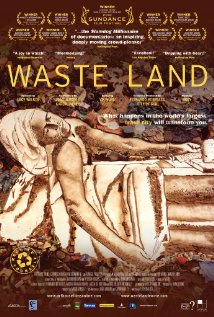
 I recently had the privilege to watch a wonderful documentary: Waste Land. It’s a beautiful film that stirred my soul with both sorrow and hope. I want to tell you about the movie and then offer some thoughts about its message.
Waste Land was directed by Lucy Walker with soundtrack by Moby. It received an Academy Award Nomination in 2011 for Best Documentary Feature.
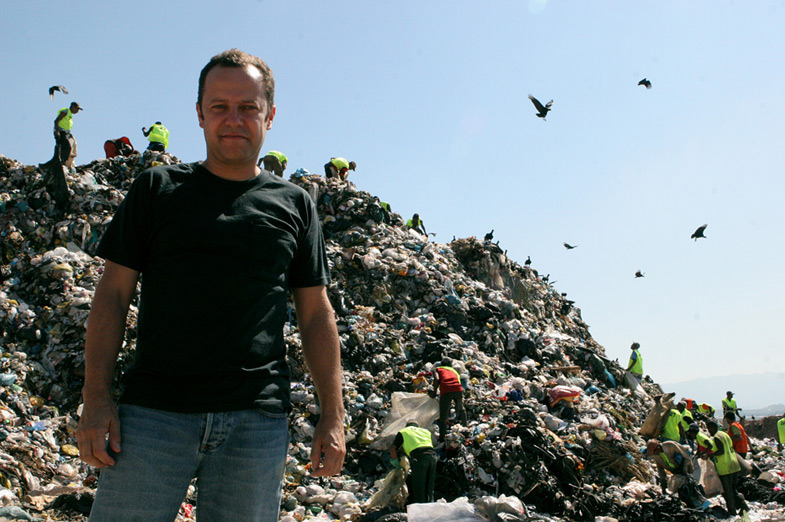
The film follows the journey of Brazilian born contemporary artist Vik Muniz to Jardim Gramacho, the world’s largest landfill located just outside of Rio de Janeiro. Here we meet an array of characters called catadores, the “pickers” of recyclable materials who sell their goods for profit in order to survive. We enter the stories of these men and women who crack jokes, quote Machiavelli, pass along proverbial wisdom, and generally put a good face on their existence in the dump.
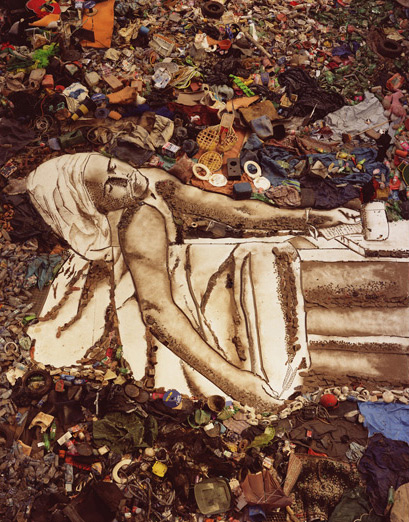
Muniz recruits several “pickers” to help him create works of art by beautifully shaping the trash from the landfill into images of the broken people who work there. These inspiring “self-portraits” (the pickers are in a sense painting themselves) are a perfect collision of dignity and despair. Art made from trash. Something good from something broken. The images themselves are magnificent, and so is the message–there are no “throwaways.”
 The creation of these works of art reminds the catadores that they are of great value. As the art of their own faces comes into view, they begin to open up. They share more honestly about the struggles and pain of their lives, but they also see more clearly the nobility of their lives. This juxtaposition gives the film its power. The irony of the title, Waste Land, is in full view here. Out of supposed waste, beauty emerges.
Beyond Waste Land
What I love about Waste Land is the reminder that humanity is beautiful. In all of the pain and pleasure, sadness and joy, evil and goodness of human lives, God has placed an inherent value in us that cannot be overlooked for long. We are the stuff of novels and paintings and songs and poems and food and dance and laughter.
 Followers of Jesus know why this is true. God has set eternity in our hearts, and at some level we remember what we were created to be. When we experience a work of art that is true and beautiful, it awakens in us a memory of how things ought to be. It makes us mourn a world where things are broken and long for a world where all things are whole again. Too often, we turn down the volume of this proclamation, but a faint echo summons us to remember our Creator and to long for our redemption.
When we experience works of artistic beauty, portraits of human nobility, signs of grace and redemption, we should look beyond these to the one who made them. God has placed hints of himself in the world to be pursued. Like bread crumbs on the road, not dropped by accident, they serve a purpose to lead us to God.
 The Bible says that we humans bear the image of God. The day he made us, God himself said that humanity was “very good.” He puts his fingerprints on each of us. Our Creator dreamed us up as his special creation and has chosen us to carry his glory in the world. Even in our sin-tainted state, we are noble. Evil has defaced the image of God in us, but it has not been erased. It is this mark of God the Creator on us that gives us a dignity that cannot be taken away. Humanity’s greatest stamp of approval is the incarnation of Jesus, who being eternal God also took on flesh and became one of us. Nothing could speak more loudly of the significance of human life.
This truth has huge implications for all people, but it ought to especially instruct us about our care for the poor, the forgotten, the abused, the unborn, the disabled, the suffering. They too bear the imprint of God. Even the people that our cruel world casts off as trash are God’s glorious creation. There is a dignity in every human life that is worthy of our love.
But there is also a potential danger in speaking of the glory of our humanity. We might be tempted to worship ourselves as the ultimate source of dignity and beauty. At one point in the film, after the auction of his painting nets a huge sum, Tiaõ says, “God was so good to me, so wonderful.” Vik Muniz, the artist, interrupts him and says, “You’re the strong one. You are the one who is doing everything.” Whether intended or not, God is excluded from the conversation, and Tiaõ himself is seen as the ultimate strength and beauty. Now, I do not know anything of Mr. Muniz’s spirituality, so I do not intend this as a statement about his faith or lack of faith. But I think the passing comment highlights a temptation for us. Muniz’s remark cuts off the pursuit of beauty before it reaches its ultimate end. It stops short of its goal. It effectively says, “Let’s honor the beauty of humanity, but let’s not ask where that beauty originates.”
If, however, we fail to pursue this beauty beyond ourselves, we deny the full power of art. Just as the beauty of a work of art directs us to the artist, so the beauty of humanity directs us to the Creator. In this sense, I believe Vik Muniz likely has a sense of what I mean, but he fails to follow the logic all the way through. In the film, Muniz does not praise himself or his work, but he allows the people and the works of art to speak for him. He knows that art reflects the artist; the beauty of his artwork points people to his skill as an artist. Since that is true, would it not seem wise to allow the beauty of humanity on the whole to point us to the ultimate Artist?
 One of my favorite lines in the documentary deals with our sense of perspective. Muniz looks out over the unending slums and shanties and buildings of Rio de Janeiro and observes, “They are not pretty places except when you look from far away.” It is a poignant comment that is also true of the portraits he is creating from recyclable trash. I couldn’t help but think that perhaps we should try to see our world from even further away. From God’s perspective, there is greater beauty in our world than we can imagine in the midst of it.
The Gospel says that humanity was broken and discarded on the trash heap of life, but Jesus came to rescue and restore us. He redeems us, gives us a new perspective, and fills us with a new hope. In Jesus, we discover that we are a part of a living and cosmic work of art. The Scripture says that “we are his workmanship,” and he is forming us into something wonderful. It is Jesus, not us, that finally transforms our lives into something wonderful. Our ultimate nobility and beauty comes as Jesus creates and recreates until we experience a new heavens and a new earth where joy and peace rule forever.
The most powerful line in Waste Land occurs when Tiaõ looks at the beauty of his completed portrait and says, “I never imagined I’d become a work of art.” The statement reveals a fantastic combination of humility and glory. It is as though Tiaõ realizes his smallness and his greatness in the same moment.
Perhaps followers of Jesus have something to learn from this. The Gospel says that God is making broken and sinful people into a new and beautiful work of art. Because of this, we should live with a constant sense of humility and glory, smallness and greatness, brokenness and beauty. This is the art of God’s grace on the canvas of the universe.
Is it easy for you to lose sight of the beauty and dignity of human life? How would it impact you if could gain a new perspective and see your life as a part of God’s cosmic work of art?
-jdl
All photo and artwork rights and credit to Waste Land or Vik Muniz at the following:
- Waste Land website: www.wastelandmovie.com
- Vik Muniz website: www.vikmuniz.net

 Three quick observations help us learn something about the appointment of elders in church plants.
 Five years ago, I had the privilege of teaching a History of Doctrine course to a group of 43 graduate students in India. As I taught these young students, my heart was jolted by their commitment to Christ. In the course of 18 days, I preached, taught for 5-6 hours per day, graded work late into the night, met with students in my makeshift office, and shared tea and meals with these remarkable students. During this time, I had the chance to be both teacher and student.
  I was humbled as I watched G–, a student with a learning disability who had once been rejected by his family as a failure, give up cricket games to study my notes (I was told he had to read them three times in order to understand). G– scored 98% in the course (much better than I had done as a student!). One employee at the school was a wonderful fifteen year old young lady that had recently been rescued from human-trafficking as a bride-for-sale. Another student said he dreamed of turning his tribal people from head-hunters to soul-hunters, and I’m certain that he was being serious. When I witnessed the ridiculous levels of poverty in Delhi, I was undone. It honestly took me six weeks to recover (meaning that it took six weeks to become somewhat numb again to the hardship).
 One connection that gripped me was a student I’ll call M–. M– is from China, although his father is Burmese. After pastoring 4 years as a teenager, he snuck across the border from China to Myanmar (Burma) and then into India en route to bible college and seminary. Without any stops, that was a ten-day journey on busses and trains. He acknowledged that he shouldn’t be in India because China wouldn’t give a visa for this, but this was the only way he would become trained as a pastor. He had not seen his mother, father, brothers or sisters in five years. His father died while he was away, and he received a brief phone call from a relative. He planned to return to China and pastor a house church along the China-Myanmar border amongst his people.
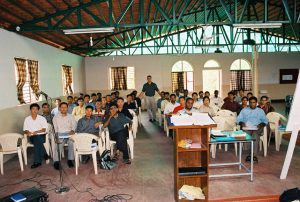 In an email to my wife, I wrote, “It is good to be here to learn from as well as to teach and encourage these young men. They truly are young men, which means that I am getting older, but it also means that the task of leading churches in these harsh areas has been left to the young, and that is a little overwhelming for me, as I think of what they will face and the fact that many of them will be forced to face it alone in a village of people hostile to all that they stand for. Gives my prayers a new sense of urgency.” I still feel that way.


 Jeff D. Lawrence ⎮ Blog